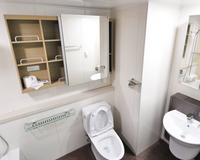

Designing a commercial restroom involves more than selecting fixtures and finishes. It requires careful attention to accessibility standards to provide a safe and functional space for everyone. The Americans with Disabilities Act sets specific legal requirements for public accommodations, and failing to meet them can lead to costly revisions and legal challenges.
Creating a restroom that passes accessibility inspections from the outset protects your business and demonstrates a commitment to inclusivity. This article outlines the key considerations for designing a bathroom that complies with ADA regulations.
Understanding ADA Guidelines
The Americans with Disabilities Act Standards for Accessible Design provides detailed technical specifications for restrooms. These rules dictate everything from the amount of clear floor space to the height of a paper towel dispenser. A fundamental requirement is a 60-inch-diameter turning space within the restroom, allowing a person using a wheelchair to make a 180-degree turn. This space must remain free of obstructions.
Key measurements are critical for compliance. For instance, you must install the grab bars at a specific height and length to provide stability. The side wall grab bar must be at least 42 inches long and positioned no more than 12 inches from the rear wall. The rear grab bar must be at least 36 inches long. The centerline of the toilet must be sixteen to eighteen inches from the side wall or partition. Toilet seats must be seventeen to nineteen inches above the finished floor. Strict adherence to these dimensions is essential for passing an accessibility inspection.

Design and Layout Considerations
The layout of an accessible restroom directly impacts its usability.
Clear Floor Space
Beyond the sixty-inch turning circle, single-user restrooms need ample clear floor space. Every fixture, from the toilet to the sink, must have a clear floor space of at least thirty by forty-eight inches to permit a forward or parallel approach by someone in a wheelchair. This space can overlap with other required clearances, including the turning space, which allows for more efficient layouts in smaller rooms.
Fixture Placement
The placement of fixtures is equally important. Toilets must meet the height and centerline requirements mentioned earlier. Sinks should be mounted with the rim no higher than thirty-four inches from the floor, and they must have knee clearance underneath. This clearance area needs to be at least 27 inches high at the front of the sink, tapering to 9 inches at the back. Faucets should be operable with one hand and not require tight grasping, pinching, or wrist twisting. Lever-operated, push-type, and electronically controlled faucets are compliant options.
Other Elements
Other elements also require attention. Mirrors located above sinks must be mounted with the bottom edge of the reflecting surface no higher than forty inches from the floor. Alternatively, provide a full-length mirror. Dispensers for soap, paper towels, and toilet paper must be within reach and be workable with a single hand. These considerations for commercial restroom accessories are vital for a fully compliant design.
Common ADA Violations and How To Avoid Them
Many accessibility issues arise from simple, avoidable mistakes.
Incorrect Grab Bar Installation
One of the most frequent violations is the incorrect installation of grab bars. This mistake can involve mounting them at the wrong height, using the wrong length, or failing to provide adequate reinforcement in the wall to support the required 250 pounds of force. To avoid this, project plans must specify the exact location and type of blocking needed within the walls before you have the drywall installed.
Restroom Accessory Errors
Another common error involves restroom accessories. Soap and paper towel dispensers are often mounted too high, placing them out of reach for individuals in wheelchairs. All operable parts of these accessories should be no more than forty-eight inches above the floor. Similarly, door hardware can present a barrier. Handles that require tight grasping or twisting are not compliant. Lever handles or push-type mechanisms are necessary. The force required to open a door is also regulated and should not exceed five pounds.
Inadequate Clear Floor Space
Finally, inadequate clear floor space at fixtures is a persistent problem. Obstructions like trash cans or exposed pipes under a sink can impede access. Plumbing beneath sinks must be insulated or configured to prevent contact with hot water pipes, protecting against burns. You must plan all elements to maintain the required clearances. Diligent review of design documents and careful oversight during construction can help prevent these common pitfalls and ensure a successful inspection.

Resources for Compliant Design
Navigating the complexities of ADA standards can be challenging, but several resources are available to help. The official ADA website, operated by the US Department of Justice, provides the complete standards and technical assistance materials. The United States Access Board also offers guides, animations, and a helpline to answer specific accessibility questions. These official sources are the most reliable references for compliance.
For designers and contractors, detailed checklists can be invaluable. Many architectural firms and accessibility consultants publish checklists that break down the ADA standards into a more manageable format for on-site verification. These tools help track compliance for every element of the restroom, from door widths to mirror heights. Using a comprehensive checklist throughout the design and construction phases helps catch potential issues early, saving time and money.
ADA Compliance Benefits
Compliance with the Americans with Disabilities Act (ADA) offers numerous benefits for businesses, organizations, and the general public.
Commitment to Accessibility and Inclusivity
Adhering to ADA standards demonstrates a commitment to inclusivity and accessibility, ensuring that facilities are welcoming and usable for individuals with disabilities. This dedication fosters goodwill within the community and also expands access to a broader customer base, as accessible spaces cater to individuals with varying needs.
Risk Reduction
Maintaining ADA compliance reduces the risk of legal liabilities and costly fines, as non-compliance can result in lawsuits or penalties.
Benefits Everyone
Beyond legal and financial considerations, creating accessible facilities enhances overall usability, benefiting people of all abilities, including seniors, parents with strollers, and others who may face temporary or situational mobility challenges. Prioritizing ADA compliance ultimately promotes equality, enhances public perception, and contributes to a more inclusive society.
Building for Everyone
Designing an accessible restroom is a technical task that carries significant responsibility. It is about creating a space that is genuinely usable for people with diverse abilities. By understanding the core ADA guidelines, carefully considering layout and fixture placement, and avoiding common mistakes, you can create a restroom that not only passes inspection but also serves every user with dignity. A compliant restroom reflects a broader commitment to inclusivity and good business practice.